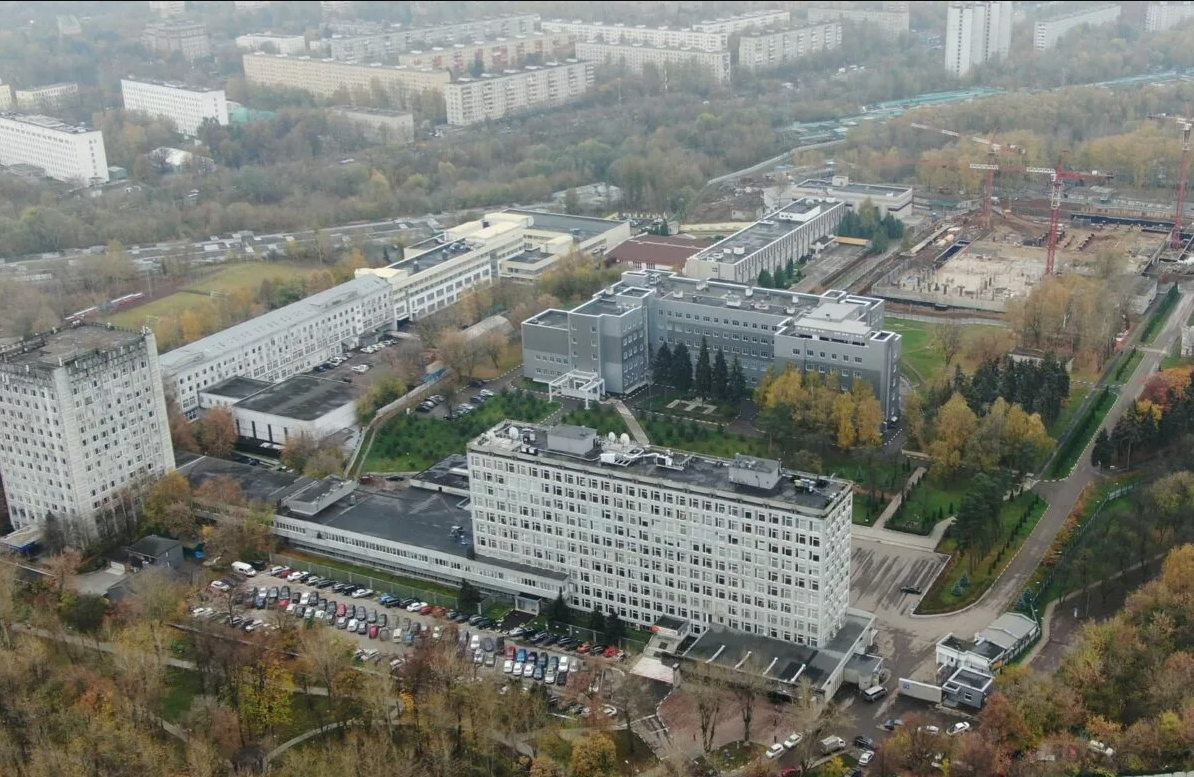
Agenstvo has discovered that scientists from the Signal research center, which helped organize the poisoning of Alexei Navalny with Novichok in 2020, secretly published an article on the synthesis of epibatidine analogues in 2015. In this paper, the authors are presented as employees of a private company, but thanks to leaks and studying their past works, we were able to establish that six of the seven scientists involved in the publication are full-time employees of Signal. Some of them played an important role in the work on the use of Novichok and other toxic substances.
Details. The article was published in the magazine Izvestiya Akademii Nauk. Seria Khimicheskaya (News of the Academy of Sciences. Chemical Series). It proposes a convenient and several times faster (16 hours instead of 70) «one-step synthesis method» for analogues of epibatidine. In other words, the scientists proposed a quick way to create a synthetic analogue of a neurotoxin that can only be found in nature on the skin of an Ecuadorian tree frog.
- The article claimed that its authors were employees of OOO «High Technology Laboratory.» This is a private company founded in 2003 by renowned chemist Igor Zavarzin, who worked for many years at the Institute of Organic Chemistry of the Russian Academy of Sciences (he now heads the «Steroid Compounds Laboratory» there). However, this structure seems more like a front or cover than a real business — leaks show that in 2019, it only had two employees.
- According to leaked pension fund data, the authors of the article were not employees of this laboratory. However, six of the seven co-authors are full-time employees of the Signal Research Center. They are chemists Igor Babkin, Sergei Galan, Georgy Nazarov and Alexei Aksenov, as well as Olga Yudina (known to be a senior researcher at the 22nd laboratory of the research and production department), and Alexei Lamanov (head of the 23rd laboratory of the research and production department). The only co-author who Agentstvo was unable to connect to Signal in any way is Colonel Mikhail Gutsalyuk. He is the head of the department for the organization of scientific work and training of scientific and teaching staff at the Military Academy of Radiation, Chemical, and Biological Protection.
- In March 2025, Zavarzin, the founder of High Technology Laboratory, was also listed as a research fellow at Signal’s 23rd laboratory. According to SPARK-Interfax data, the company supplied Signal with raw materials and reagents.
- In a comment for The Insider, an anonymous Russian chemist suggested that the epibatidine used to poison Navalny was synthesized at Signal. The scientist studied articles on epibatidine by another enterprise involved in the creation of Novichok — the State Research Institute of Organic Chemistry and Technology (GosNIIOKhT) (more about them).
- Quote: «Apparently, epibatidine was obtained not at GosNIIOHT, but at Signal: the Diels-Alder reaction, amino group protection, and cyclization (typical steps in organic synthesis, — Agentstvo) — these are all Babkin’s areas of expertise, and the production of carfentanils, palladium on carbon could have been done by Sergei Galan. So, I am almost certain that it was done by the Signal center, but apparently at that time Signal either did not yet have the facilities for preclinical trials or did not have enough manpower, so they outsourced it to GosNIIOKhT».
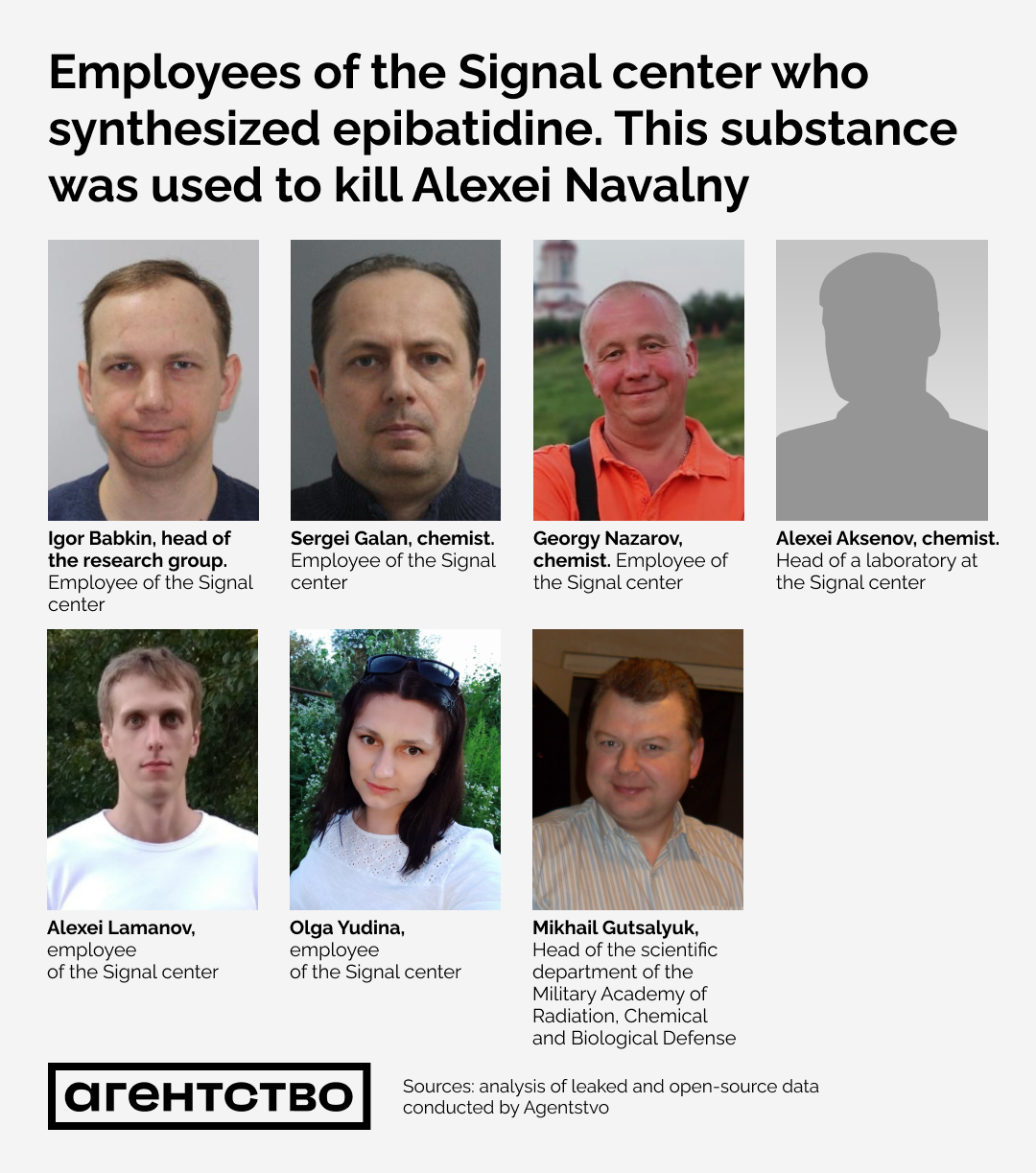
What are the authors of the article known for? The group that synthesized epibatidine analogues was led by the same Babkin who was mentioned by the anonymous chemist, wrote Anatoly Vereshchagin, a leading researcher at the Institute of Organic Chemistry of the Russian Academy of Sciences, in a scientific paper. According to leaks, Babkin has been working at Signal since at least the mid-2010s. He and Galan represented the center at the MOBY-ChemPharma2018 symposium. In the 2000s, Babkin worked at the Military Academy of Radiation, Chemical, and Biological Protection and, like Signal director Artur Zhirov, at the 27th Scientific Center of the Ministry of Defense.
- In addition, Babkin is the co-author of a patent of the Ministry of Defense’s 27th Scientific Center for the «Method for obtaining methyl4-[(3,4-dichlorophenyl)acetyl]-3-[(1-pyrrolidinyl)methyl]-1-piperazinecarboxylate.» This substance belongs to the class of opioid k-receptor antagonists. Radio Liberty wrote that this class also includes substances like carfentanil and remifentanil, toxins that Russian special services used during the storming of the Dubrovka theater during the 2002 terrorist attack (more than 100 hostages died from the effects of the «sleeping» gas). Babkin’s co-authors on the article on the synthesis of epibatidine, Galan and Nazarov, are also co-authors of this patent.
- Galan and Nazarov are experts in the field of nanoencapsulation, which Signal has been actively researching, as reported by The Insider and Radio Liberty in 2020. Nanoencapsulation is a technology for packaging nanoparticles of a substance in a shell made of another substance. It was probably used with Novichok. Nanoencapsulation can be used to mask poison, hide its symptoms, and make diagnosis difficult. Galan and Nazarov studied nanoparticles as a way to deliver «medicines» to various tissues in the body, primarily to cells in the nervous system.
- As of 2019, Galan combined his work at Signal with a position as a research fellow at the State Research and Testing Institute of Military Medicine (its head, Sergei Chepur, advised the GRU officers who poisoned Sergei and Yulia Skripal), and previously worked at the 27th Research Center of the Ministry of Defense. Like Galan, Nazarov combines his work at Signal with another job—he was also listed as a senior researcher at the 27th Research Center of the Ministry of Defense. In addition, Galan, Nazarov, Lamanov and Yudina worked in the 41st laboratory of the 4th department of the Federal State Unitary Enterprise «Research Institute of Applied Acoustics,» which, despite its name, is engaged in the development of chemical weapons.
- Another co-author of the Signal article, Alexei Aksenov, describes in other scientific works the extraction of various substances from plants, including those growing in exotic locations. Among them are the roots of Oplopanax horridus from North America and the bark of Cinnamomum from China, Vietnam, Indonesia, and Sri Lanka.
Context. Last Saturday, five European countries issued a joint statement on the poisoning of Alexei Navalny with epibatidine. At the same time, Agentstvo noticed that this substance is mentioned on the website of GosNIIOKhT. Back in the Soviet era, this enterprise developed Novichok, the poison used in the 2020 poisoning of Alexei Navalny.
- In the 2010s, GosNIIOKhT employees published three scientific articles on epibatidine. In them, scientists described the preparative method for obtaining the analgesic epibatidine, tests of endo-epibatidine on laboratory animals, and a method for determining microquantities of epibatidine in blood plasma. Signal’s article on the synthesis of epibatidine was written in 2015, the same year as GosNIIOKhT’s last publication.
- In previous poisoning cases, which were studied in detail by investigators, GosNIIOKhT employees were hardly mentioned, while Signal played a key role. It was with the help of Signal employees that the Russian special services used Novichok to poison Navalny in 2020, and former intelligence defector Sergei Skripal and his daughter Yulia in the UK in 2018. Signal head Artur Zhirov repeatedly called the FSB poisoners who were preparing to kill Navalny in 2020, as well as the head of the St. Petersburg Institute of Military Medicine, Sergei Chepur, during the period of his involvement in the preparation of the Skripal assassination.
Больше новостей, о которых боятся писать в России, — в наших аккаунтах в Telegram, Twitter, Facebook и рассылке «Агентства»